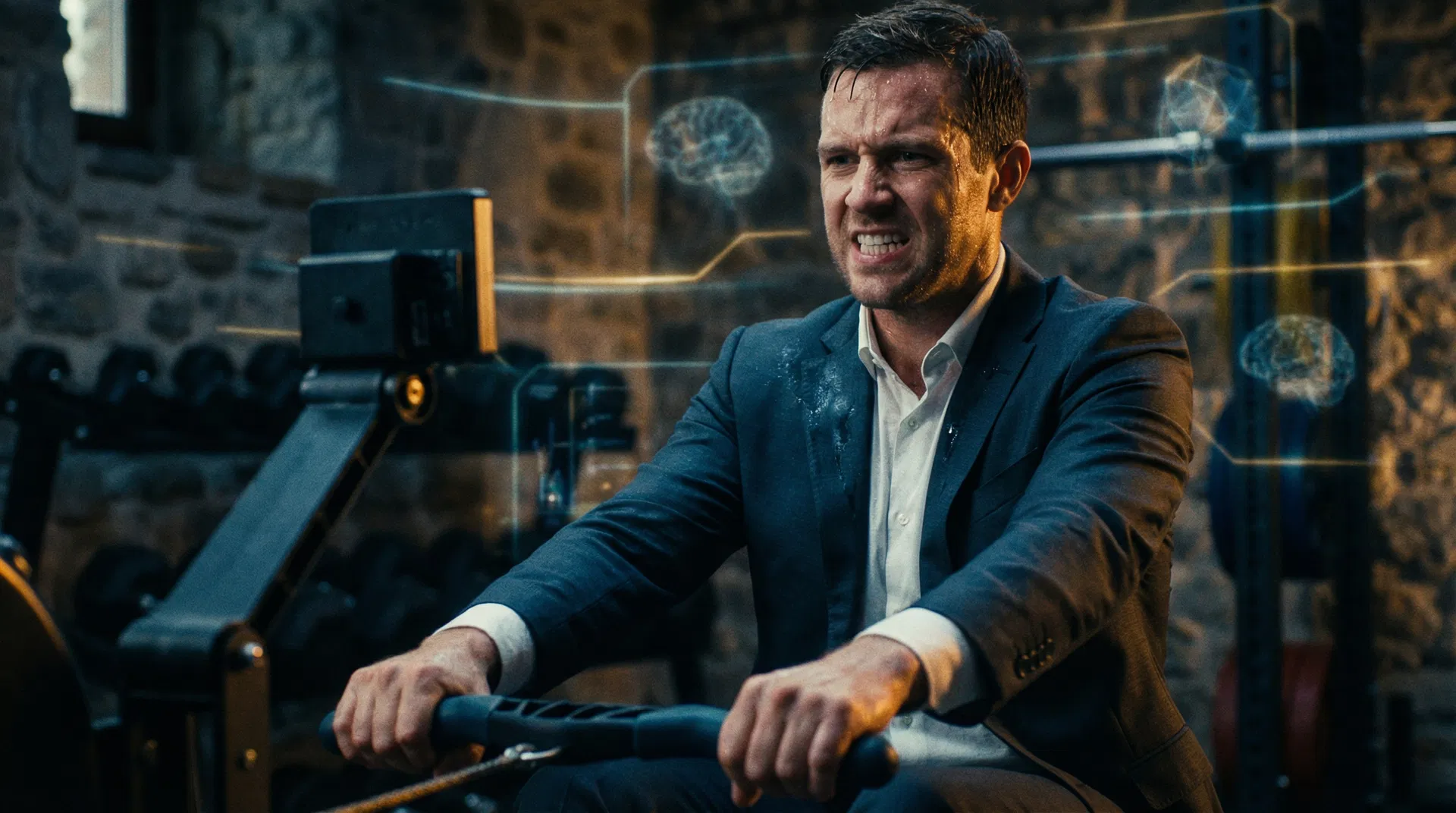
As AI automates routine decisions, the executive's value lies in cognitive endurance — the ability to sustain high-quality thinking under pressure. Research shows HIIT is the most effective protocol for building this capacity.
— The Silent Epidemic in the C-Suite
There is a crisis unfolding in executive suites across Sri Lanka and the world — one that no quarterly report captures and no board meeting addresses. It is the epidemic of cognitive decline among leaders who are physically capable of running their organizations but mentally exhausted from doing so.
Executive fatigue is not ordinary tiredness. It is a progressive degradation of the brain's executive functions — the very capabilities that justify a leader's position: strategic planning, complex problem-solving, emotional regulation, and the ability to synthesize vast amounts of information into decisive action. When these functions deteriorate, the executive doesn't suddenly fail. They slowly become mediocre. And mediocrity in leadership is the most expensive liability any organization can carry.
— The AI Paradox: Why Automation Makes Your Brain More Important
The rise of artificial intelligence has created a paradox that few business leaders have fully grasped. As AI systems take over routine analytical tasks — financial modeling, market analysis, operational optimization — the remaining decisions that require human judgment become exponentially more complex and consequential.
In the AI decade, the executive's value is no longer in processing information (machines do that better). It lies in three irreplaceable cognitive capabilities: creative synthesis (connecting disparate ideas into novel strategies), ethical judgment (navigating moral complexity that algorithms cannot resolve), and interpersonal leadership (inspiring and aligning human beings around a shared vision).
Each of these capabilities demands sustained cognitive performance under pressure. And here lies the critical insight: the brain is a biological organ that responds to physical training just as muscles do. Neglect it, and it atrophies. Train it properly, and it performs at levels that untrained brains simply cannot match.
— The BDNF Revolution: Your Brain's Performance-Enhancing Drug
Brain-Derived Neurotrophic Factor (BDNF) is, without exaggeration, the most important molecule in the executive's biological arsenal. Often called "Miracle-Gro for the brain," BDNF promotes neuroplasticity (the brain's ability to form new neural connections), neurogenesis (the creation of entirely new brain cells), and synaptic strengthening (making existing neural pathways faster and more efficient).
Research published in the Journal of Cognitive Neuroscience demonstrates that High-Intensity Interval Training (HIIT) — the type of training central to the TEJAS methodology — produces the most significant increases in BDNF levels compared to any other form of exercise. A single HIIT session can elevate BDNF levels by up to 300%, with regular training creating sustained baseline increases.
For the executive, this translates into measurable cognitive advantages: a 38% improvement in executive function (the ability to plan, organize, and execute complex tasks), enhanced information processing speed (faster synthesis of complex data streams), improved inhibitory control (the ability to resist impulsive decisions — critical when AI systems present seductive but flawed recommendations), and superior emotional regulation (maintaining composure during high-stakes negotiations and crises).
— The TEJAS Protocol: Martial Arts as Cognitive Training
What distinguishes the TEJAS approach from conventional fitness programs is the integration of martial arts — specifically Taekkyeon and boxing — as cognitive training tools. While a standard HIIT session on a rowing machine or treadmill provides the cardiovascular stimulus for BDNF release, it does not challenge the brain's higher functions during the exercise itself.
Taekkyeon sparring, by contrast, demands simultaneous physical exertion and complex cognitive processing. The practitioner must read their opponent's body language, anticipate attacks, formulate counter-strategies, and execute precise movements — all while maintaining the cardiovascular intensity that drives BDNF production. This dual-channel training creates a cognitive adaptation that no gym workout can replicate.
Boxing adds another dimension: the requirement to make split-second decisions under the threat of physical consequence. When an executive trains to maintain strategic clarity while a boxing partner is actively trying to land punches, the stress of a difficult board meeting becomes, by comparison, almost comfortable.
— The Brain Care Score: Measuring What Matters
Recent research from the American Heart Association has introduced the concept of a "Brain Care Score" — a composite measure of brain health that correlates directly with cognitive performance and long-term neurological resilience. Studies show that a mere 5-point increase in this score is associated with a 43% lower risk of cardiovascular disease and a significant reduction in cognitive decline.
The TEJAS Executive Warrior program incorporates Brain Care Score assessment as a key performance metric. Unlike traditional fitness assessments that measure only physical capacity, the Brain Care Score evaluates the factors that directly impact executive performance: cardiovascular health (which determines blood flow to the brain), sleep quality (which affects memory consolidation and emotional regulation), stress management (which influences cortisol levels and their impact on the prefrontal cortex), and physical activity patterns (specifically the type and intensity of exercise).
For the executive who views their brain as their primary business asset — which it is — the Brain Care Score provides the same kind of objective performance data that a P&L statement provides for their organization. You cannot improve what you do not measure.
— The Cost of Inaction
The executive who dismisses physical training as a luxury or a vanity project is making a strategic error of the highest order. In the AI decade, cognitive performance is not a nice-to-have. It is the fundamental differentiator between leaders who thrive and those who are gradually replaced — not by AI, but by other humans who have invested in their cognitive capacity.
The science is unambiguous: High-Intensity Interval Training, combined with the cognitive demands of martial arts practice, produces measurable, significant improvements in the exact brain functions that define executive excellence. The question is not whether you can afford to invest in this training. The question is whether you can afford not to.
As the saying goes in the TEJAS methodology: "Health leads to Wealth." But more precisely: cognitive health leads to cognitive wealth — the sustained mental capacity to see opportunities others miss, make decisions others avoid, and lead with a clarity that inspires confidence in everyone around you.
Your brain is your most valuable business asset. The TEJAS Executive Warrior program is designed to optimize it through scientifically-grounded training protocols.
Continue Reading
More Insights
 Martial Arts & Strategy
The Taekkyeon Rhythm
How a 2,000-Year-Old Footwork Pattern Can Save Your Business Strategy
 Leadership & Psychology
Why Your Ego is Your Greatest Competitor
Lessons from the Boxing Ring and the Boardroom
 Military Leadership & Business
From Ramadi to Colombo
Applying Navy SEAL Accountability to the Sri Lankan Corporate Landscape
 TEJAS — Executive Warrior Training
Designed & Developed by Jayampathy Balasuriya