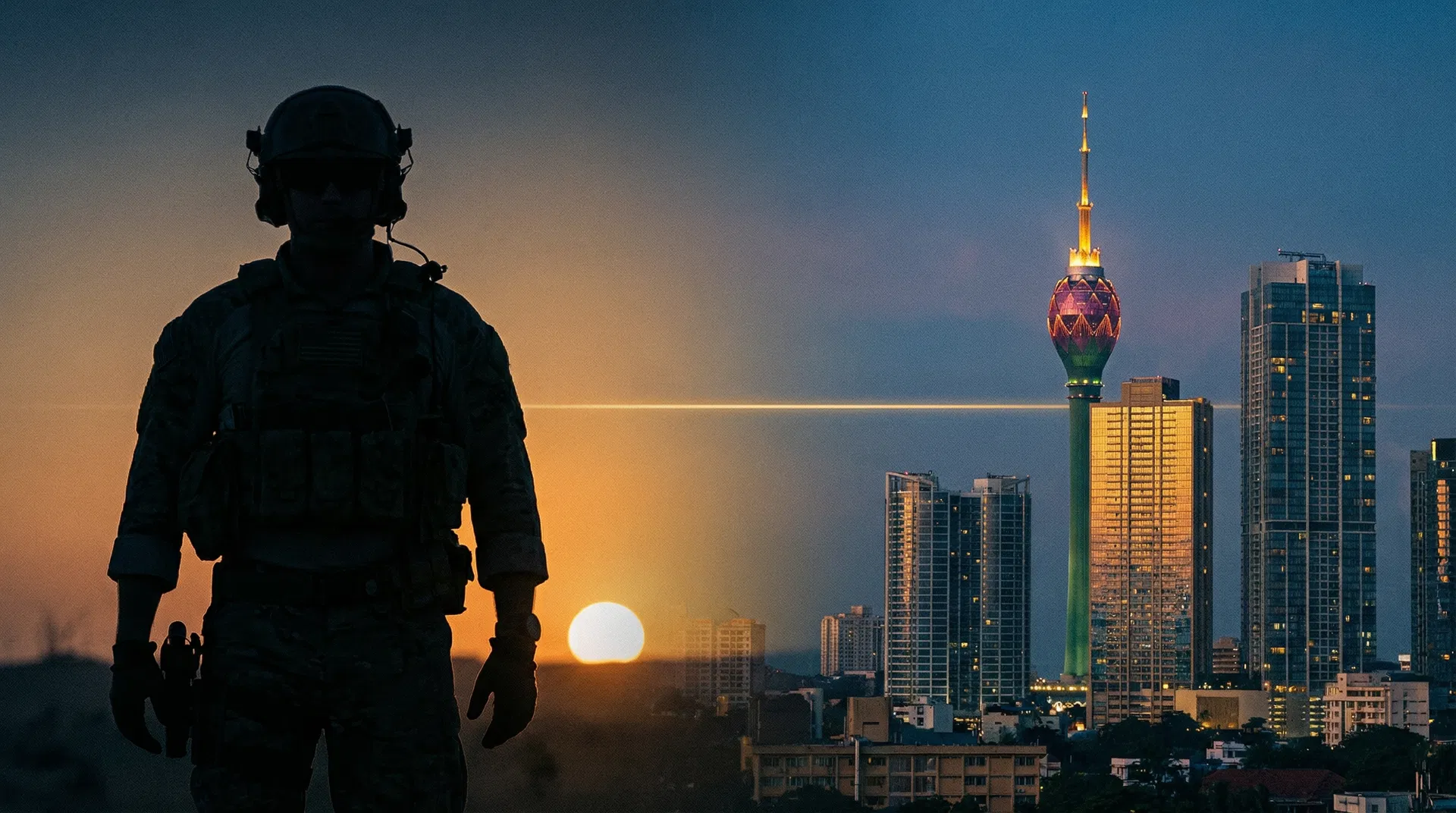
The Battle of Ramadi taught the world's most elite warriors that 'there are no bad teams, only bad leaders.' This article explores how those battlefield principles are being adapted for Sri Lanka's emerging executive class.
— The Battle That Changed Leadership Forever
In 2006, the city of Ramadi in Iraq's Anbar Province was the most dangerous place on earth. Al-Qaeda in Iraq had declared it the capital of their caliphate. American forces were taking casualties at an alarming rate. Conventional military strategy had failed.
Into this chaos stepped SEAL Team Three's Task Unit Bruiser, led by commanders who would later articulate the leadership principles that emerged from their experience. What they discovered in the streets of Ramadi was not a new tactical doctrine. It was a fundamental truth about leadership that applies as powerfully in a Colombo boardroom as it did in an Iraqi combat zone: there are no bad teams, only bad leaders.
This single principle — and its implications — forms the backbone of the TEJAS Executive Warrior methodology's leadership component. Not because war is a metaphor for business (it isn't), but because the extreme conditions of combat strip away every comfortable illusion about leadership and reveal what actually works.
— The Sri Lankan Context: Why This Matters Now
Sri Lanka's corporate landscape is at an inflection point. The economic challenges of recent years have created an environment that, while not physically dangerous, demands the same qualities that define effective combat leadership: clarity under pressure, decisive action with incomplete information, and the ability to inspire teams through uncertainty.
The traditional model of Sri Lankan corporate leadership — hierarchical, relationship-driven, and often risk-averse — served well in a more stable economic environment. But the current reality demands something different. It demands leaders who can own their failures without deflection, make hard decisions without consensus paralysis, and maintain standards without compromise.
This is not a cultural criticism. It is a recognition that the competitive landscape has changed, and the leadership capabilities required to navigate it have changed with it. The executives who adapt will thrive. Those who don't will be gradually displaced by those who do — whether local competitors or international entrants who bring these disciplines as standard practice.
— Principle 1: Extreme Ownership in Practice
In Ramadi, when a SEAL operation went wrong — and operations frequently went wrong in the chaos of urban combat — the leader's first response was not to identify who was at fault. It was to identify what they, as the leader, could have done differently. This is Extreme Ownership in its purest form.
For the Sri Lankan executive, this translates into a radical shift in accountability. When a product launch fails, the CEO doesn't blame the marketing team. They ask: "Did I provide clear enough strategic direction? Did I ensure the team had the resources they needed? Did I create an environment where people felt safe raising concerns before the launch?"
This is not about self-flagellation. It is about creating a culture where accountability flows upward, not downward. When the leader consistently takes ownership of failures, two things happen: the team stops hiding problems (because they know the leader won't punish them for honesty), and the leader gains access to the real information they need to make better decisions.
In the TEJAS training environment, this principle is practiced physically. When a training session goes poorly — when the executive can't complete a boxing combination or loses their rhythm in Taekkyeon practice — the response is not excuses. It is analysis: "What did I do wrong? What can I do differently? How do I improve?" This simple discipline, practiced hundreds of times in the gym, becomes an automatic response in the boardroom.
— Principle 2: Prioritize and Execute Under Chaos
In combat, the volume of simultaneous threats can be overwhelming. Gunfire from multiple directions. Casualties requiring evacuation. Communications breaking down. Civilians in the crossfire. The natural human response to this level of chaos is paralysis — the brain simply cannot process all the inputs and freezes.
The SEAL response, refined through brutal experience, is a simple framework: Prioritize and Execute. Identify the single most critical threat. Address it. Then identify the next. Address that. Continue until the situation is stabilized. Never try to solve everything at once.
For the Sri Lankan executive navigating economic uncertainty, this framework is directly applicable. When currency fluctuations, supply chain disruptions, regulatory changes, and competitive pressures all hit simultaneously — as they frequently do — the temptation is to address everything at once. The result is usually that nothing is addressed effectively.
The TEJAS methodology trains this capability through physical simulation. During high-intensity training sessions, when the executive is physically exhausted, they are given complex cognitive tasks to perform — memory exercises, strategic puzzles, decision-making scenarios. The goal is not to perform these tasks perfectly. It is to develop the capacity to think clearly when every instinct is screaming for rest. This is the OODA loop (Observe, Orient, Decide, Act) used by elite military aviators, adapted for the executive context.
— Principle 3: Decentralized Command — The Sri Lankan Challenge
Perhaps the most challenging principle for the Sri Lankan corporate context is Decentralized Command — the practice of pushing decision-making authority down to the lowest capable level of the organization.
In Ramadi, this was a survival necessity. The pace of combat was too fast for every decision to flow through a central command structure. Junior leaders had to be empowered to make critical decisions independently, guided by a clear understanding of the overall mission and the commander's intent.
In many Sri Lankan organizations, the opposite culture prevails. Decision-making is concentrated at the top. Junior and mid-level managers wait for approval before acting. Information flows slowly upward and decisions flow slowly downward. In a stable environment, this works. In a volatile one, it is a competitive death sentence.
The TEJAS program addresses this through group training workshops (available in the Sovereign Legacy package) where executives practice delegating authority under pressure. The physical training environment — where split-second decisions cannot wait for committee approval — provides a visceral understanding of why decentralized command is not just efficient, but essential.
— Building the Bridge: From Battlefield to Business
The principles that emerged from Ramadi are not military principles applied to business. They are human principles — truths about leadership, accountability, and performance under pressure — that were discovered in the most extreme conditions humans can face and validated in the most demanding environment imaginable.
The TEJAS Executive Warrior program serves as the bridge between these principles and the Sri Lankan corporate reality. Through the physical practice of martial arts and high-intensity training, combined with structured leadership development modules drawn directly from the Extreme Ownership framework, executives develop not just an intellectual understanding of these principles, but an embodied capacity to execute them under pressure.
The Battle of Ramadi taught the world that leadership is not a title or a position. It is a discipline — one that must be practiced, tested, and refined continuously. For the Sri Lankan executive who is willing to embrace this discipline, the rewards are not just professional success. They are the deep, earned confidence that comes from knowing you have been tested and have not been found wanting.
From Ramadi to Colombo, the distance is measured not in miles, but in the willingness to lead with accountability, decide with clarity, and act with courage. The TEJAS methodology provides the training ground. The rest is up to you.
Leadership is a discipline, not a title. The TEJAS Executive Warrior program brings battlefield-tested accountability to the Sri Lankan corporate landscape.
Continue Reading
More Insights
 Martial Arts & Strategy
The Taekkyeon Rhythm
How a 2,000-Year-Old Footwork Pattern Can Save Your Business Strategy
 Neuroscience & Performance
Executive Fatigue vs. Cognitive Endurance
The Science of High-Intensity Training in the AI Decade
 Leadership & Psychology
Why Your Ego is Your Greatest Competitor
Lessons from the Boxing Ring and the Boardroom
 TEJAS — Executive Warrior Training
Designed & Developed by Jayampathy Balasuriya